Between December and February, the 5app team improved our communication skills by 30%.
Active listening increased by 28%.
Coaching skills rose by 25%.
Not in a workshop, not in a quarterly review, not in a simulation exercise.
In the flow of real work.
Those numbers didn’t come from a survey, or a self-assessment, or even from my own observations of the team. They came from real behavioural data captured during our day-to-day meetings.
And that’s exactly why these numbers matter.
Measuring what actually happens
At 5app, we build learning technology, so it would be slightly embarrassing if we didn’t use it ourselves. We use our own tools every day, and most recently that has meant embedding Helix, our AI skills intelligence platform, into how we work.
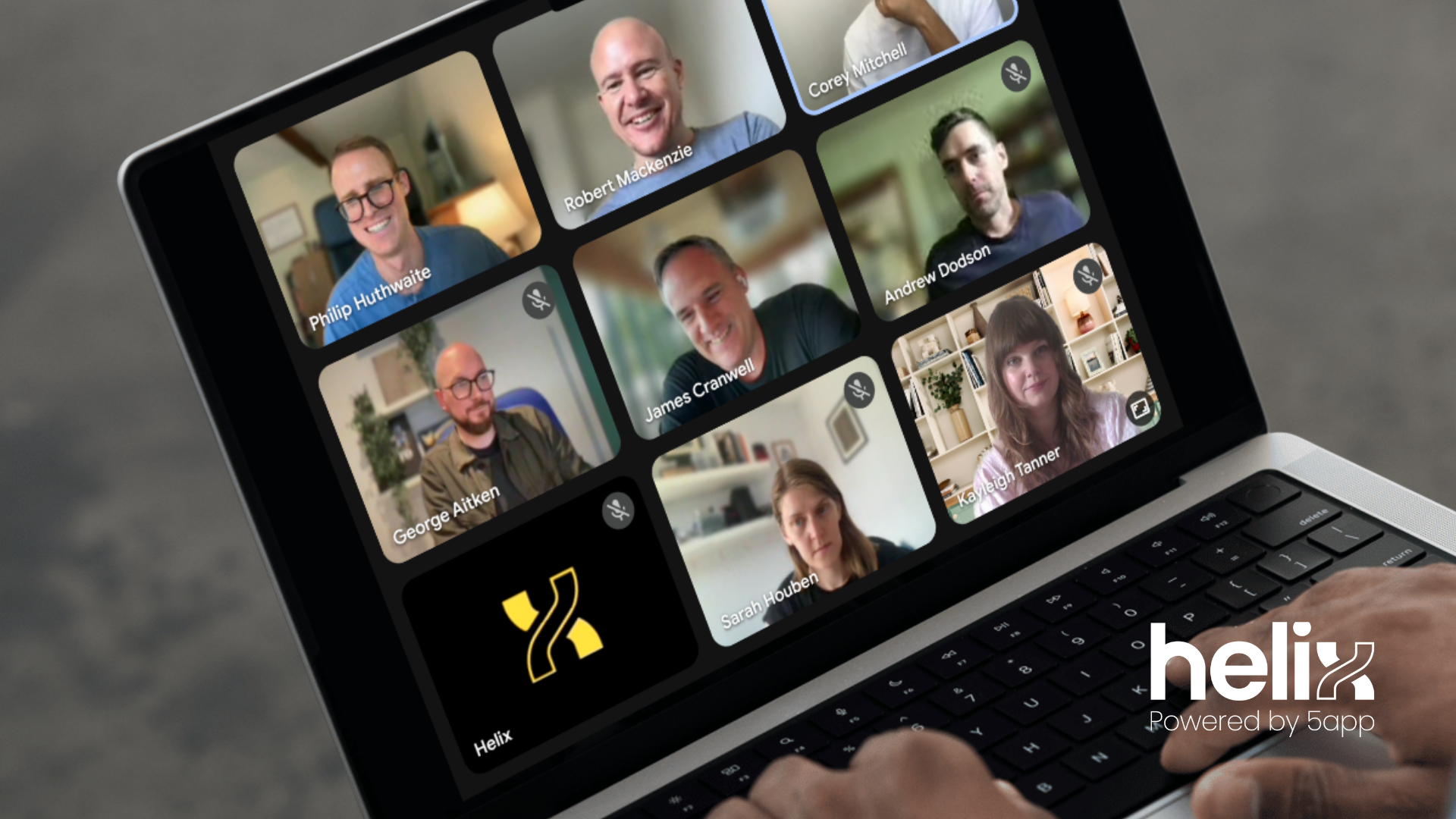
We work remotely across the UK. Like many distributed teams, our collaboration lives in Google Meets, from team stand-ups to brainstorms, 1:1s to company updates. That’s where soft skills like communication, influence, listening and coaching actually show up.
So we invited Helix to every internal meeting.
Helix quietly observes behaviour in real time during meetings. After each one, every participant receives a personalised report including:
- A skill score
- Relevant behavioural quotes
- Practical tips for improvement
- Trend data over time
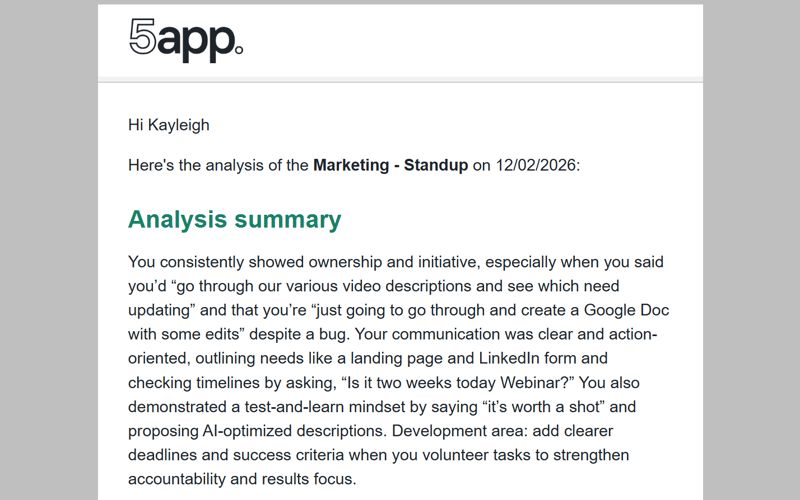
At the leadership level, we also review aggregated skills data across teams. This allows us to identify patterns, strengths, emerging gaps and opportunities for targeted learning interventions.
Instead of relying on anecdotal feedback or annual appraisals, we now make developmental decisions based on real behavioural evidence. It’s more accurate, fairer and, most importantly, it works.
The result: measurable soft skills growth
Within two months of consistent use, we saw:
- 30% improvement in communication
- 28% improvement in active listening
- 25% improvement in coaching skills
But the numbers only tell part of the story. Simply inviting Helix won’t miraculously change your organisation’s approach to soft skills development.
In fact, the most interesting shift has been cultural. Helix has made skills development visible. It has normalised conversations about how we show up in meetings. It has given people objective, unbiased feedback, not filtered through hierarchy or memory. Helix has almost become an extra member of the team. We’ve found ourselves saying, “Helix will love that!” when a colleague demonstrates exceptional skills in a meeting.
As George Aitken, our Product Marketing Manager, put it:
“Helix gives me objective, unbiased feedback on how I turn up to work. It's like an always-on, subtle therapy session, giving me in-the-moment pointers on where I can improve.
It's made me far more conscious of how I communicate. I am now sharper and more deliberate and use data to ground how my message lands.”
For me, the biggest shift is that Helix has made skills development part of our everyday conversations at 5app. It gives us the data and feedback to improve as part of our continuous learning culture, not just occasionally.
Why most organisations struggle to prove learning impact
For years, L&D has wrestled with the same question: How do we prove this is working?
Completion rates don’t tell you whether behaviour changed. Satisfaction scores don’t tell you whether performance improved. Annual reviews don’t capture growth in the moment. Most organisations are still relying on lagging indicators, subjective opinion or self-reporting.
When someone says, “I think I’ve become a better active listener”, what does that actually mean? Without data, it’s a feeling. With data, it’s evidence. Helix gives you that data. It turns gut feeling into something tangible, and in terms of learning impact, it changes everything.
The shift from content delivery to skills intelligence
What we’re seeing internally is reflecting a broader transformation in learning. AI is moving us beyond content management and into true skills intelligence.
Instead of asking:
- Who completed a course?
- Who passed a quiz?
- Which team is doing the most learning?
We can now ask:
- What behaviours are improving?
- Where are skills strengthening across teams?
- What learning intervention would move the needle next?
This is a fundamentally different model of learning impact. It’s not about proving that training happened. It’s about proving that performance changed.
The ability to measure behavioural change in the flow of work takes learning ROI from being an abstract concept to something tangible, measurable and genuinely achievable.
From anecdote to evidence: why we’ve launched our new guide
Our experience using Helix internally prompted a bigger question:
If we can see a 30% uplift in communication skills in two months, what could organisations achieve if they truly embedded skills intelligence into their learning strategy?
That’s why we’ve launched our new guide on measuring learning impact in the age of AI.
In it, we explore:
- Why traditional ROI models no longer reflect modern work
- How AI enables real-time behavioural insight
- The difference between engagement metrics and performance metrics
- How to connect skills data directly to business outcomes
- Practical steps to move from reactive reporting to proactive skills strategy
Because learning leaders don’t just need more content. They need clarity, credibility and real data that speaks the language of the board, the budget holders and the people who give your learning programmes the green light.
What we’ve learned from using Helix
Using Helix internally has reinforced something we’ve long believed: that learning is most powerful when it’s embedded, observable and measurable.
When development happens in the flow of work, supported by real-time feedback and objective data, growth accelerates. When growth is measurable, investment in L&D becomes an easier yes.
We improved communication by 30% in two months. Not because we ran more workshops or launched more elearning courses, but simply because we made skills visible and opened up a cultural conversation.
That simple skills visibility is the future of learning impact.
If you’d like to explore what that future looks like in more detail, download our new guide and see how AI-powered skills intelligence can transform the way your organisation measures, manages and maximises learning.
.jpg?width=1280&name=CEO%20Series%20Blog%20(4).jpg "We improved communication by 30% in two months. Here's what that means for L&D")