---
title: 4 ways L&D leaders use AI skills intelligence to measure learning impact
description: Leadership development, coaching QA, training QA and sales enablement are just four of the ways companies can use Helix for AI skills intelligence.
image: https://5app.com/hubfs/CEO%20Series%20Blog%20(6).png
---
[](https://5app.com)
- Products
Meet 5app
- [**Helix**](https://5app.com/helix)
- [VeeCoach](https://5app.com/vee-coach)
- [The Hub LMS](https://5app.com/platform)
- [VeeCreate](https://5app.com/vee-create)
- Partners
Learn more
- [**Become a Partner**](https://5app.com/partner-with-us)
- Resources
Who we are
- [**Blog**](https://5app.com/resources)
- [Case Studies](https://5app.com/resources?post_type=case-study)
- [Newsletter](https://www.linkedin.com/build-relation/newsletter-follow?entityUrn=7076925264022122496)
- [Guides](https://5app.com/guides)
- [Webinars](https://5app.com/webinars)
- [Podcast](https://5app.com/podcast)
- [Pricing](https://5app.com/pricing)
- [See Helix in action](https://info.5app.com/see-helix-in-action)
- [Try for free](https://info.5app.com/free-coaching-skills-assessment)
CEO update
# 4 ways L&D leaders use AI skills intelligence to measure learning impact
.png?width=1280&name=CEO%20Series%20Blog%20(6).png "4 ways L&D leaders are using AI skills intelligence")
4 ways L&D leaders use AI skills intelligence to measure learning impact
6:40
30 Jun 2026 | Philip Huthwaite
*AI skills intelligence is emerging as one of the most powerful tools in learning and development. By analysing workplace behaviours and measuring soft skills [in the flow of work](https://5app.com/resources/5-ways-to-bring-learning-into-the-flow-of-work), AI skills intelligence platforms help organisations identify skill gaps, assess leadership capability and demonstrate learning impact more effectively than traditional assessments. Here's how L&D leaders are using AI skills intelligence right now to measure learning impact.*
How much do you *really* know about the skills in your business? I don’t just mean ‘Did everyone score 80%+ in their annual training assessment?’ or ‘How good do the sales team say they are at communicating with their customers?’. I mean, how do critical business skills suchas active listening or strategic vision *really* show up in day-to-day work, away from gut feeling, biased self-assessments or adhoc peer reviews?
Understanding the skills in play in your business, and how they’re changing, is tightly linked to the effectiveness of your training. For instance, did you know that around [50% of companies](https://www.td.org/product/research-report--evaluating-learning-getting-to-measurements-that-matter/191603) don’t know if their training investments are successful? This is a shocking statistic, meaning that many businesses could be wasting huge sums of money on learning programmes that just aren’t getting the right results. This lack of visibility into application of skills in the workplace leaves us with a lot of questions – and potentially a big L&D bill with nothing to show for it. That’s a gap we’re determined to close, and we believe that AI skills intelligence is the answer.
I shared my take on why it’s time to take the next step in AI skills intelligence at our Helix launch event back in July, but if you weren’t able to join us, I’m pleased to share those thoughts with you here and now. Watch the highlights of my keynote below, or read on for my full thoughts:
## How Helix works
A quick refresher for those of you who may be new to Helix:
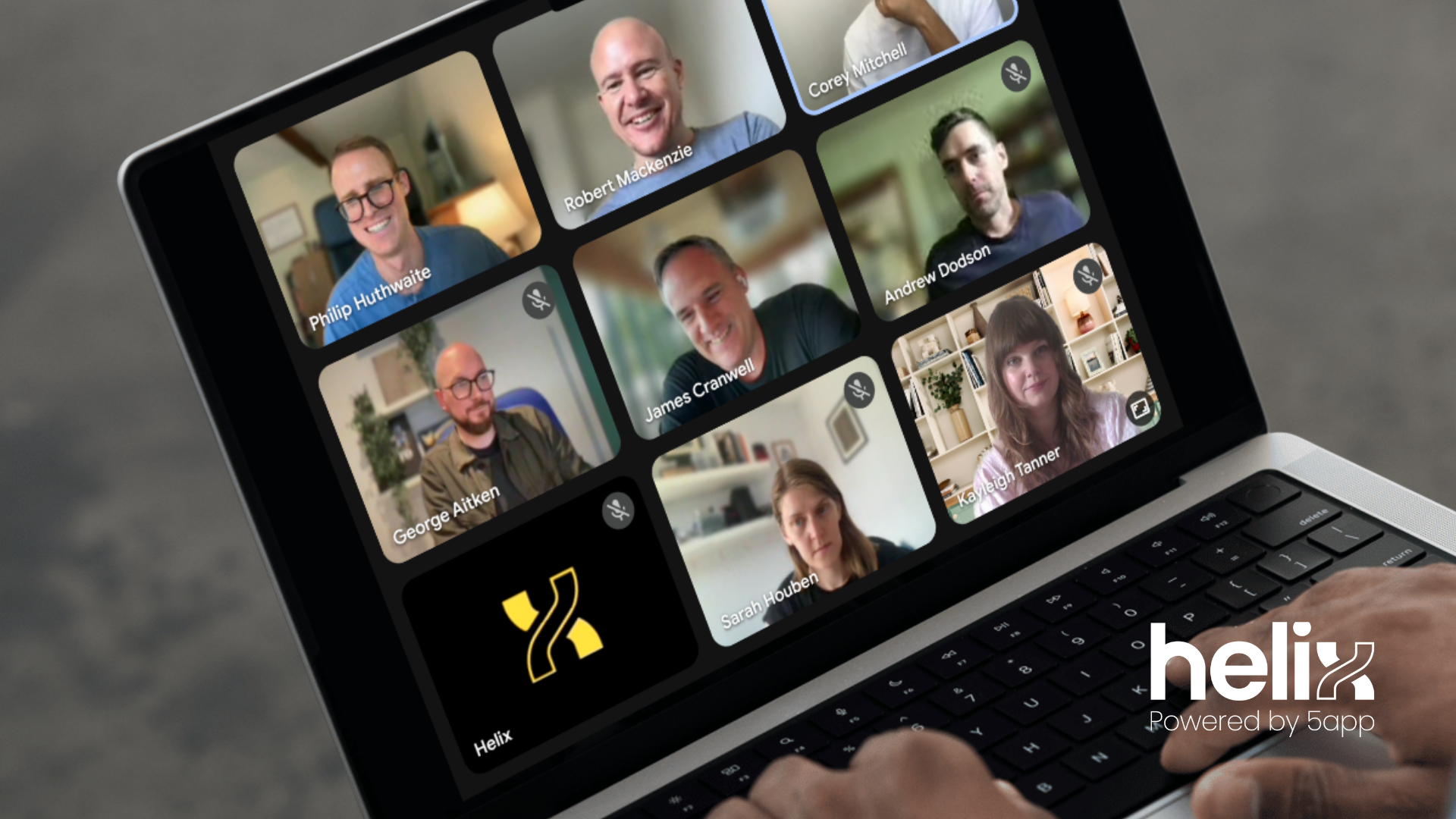
[Helix](https://5app.com/helix) turns up to your virtual meetings, whether that’s a brainstorming session, a one-on-one meeting with your manager or a team standup, just like another attendee. It listens, analyses and translates your interactions into actionable insights. For the first time ever, you’re not dependent on gut feeling or biased assumptions when it comes to [skills assessment](https://5app.com/resources/why-continuous-skills-assessments-are-todays-performance-solution) – instead, you can finally get your hands on real data, helping you start painting a true picture of your skill set.
Think of it as a smarter version of the meeting assistants we’re all familiar with, but with a laser focus on skills.
## The skills you can measure with Helix
Initially, Helix focused on analysing our [Core 9 soft skills](https://5app.com/resources/the-9-soft-skills-were-starting-with-and-why-they-matter). These cover three key areas:
- **How you show up to work** – [accountability](https://5app.com/resources/how-to-improve-accountability-at-work), [active listening](https://5app.com/resources/how-to-improve-your-active-listening-skills), [change management](https://5app.com/resources/how-to-get-better-at-change-management)
- **How you grow and lead** – [coachability](https://5app.com/resources/how-to-become-a-more-coachable-employee), [coaching](https://5app.com/resources/the-foolproof-guide-to-improving-your-coaching-skills), [communication](https://5app.com/resources/the-art-of-great-workplace-communication)
- **How you make decisions** – [growth mindset](https://5app.com/resources/moving-from-a-fixed-mindset-to-growth-mindset-at-work), [results focus](https://5app.com/resources/how-to-get-more-results-focused-at-work), [strategic vision](https://5app.com/resources/sharpening-up-your-strategic-vision)
But this is just the start. Right now, we have 90+ trackable skills in Helix, including:
- Giving feedback
- Innovative thinking
- Cultural sensitivity
- Crisis leadership
- Digital literacy
As well as skills laser-focused on specific areas, such as sales enablement and coaching quality.
But it doesn't even stop there! You can also add, track and measure your own custom skills in Helix, as well as editing existing skills to match your own definitions.
## 4 key Helix use cases
From our early access period and [conversations with dozens more L&D leaders](https://5app.com/resources/ld-is-working-hard.-its-time-for-tech-to-catch-up), we’ve found that there are four key ways businesses intend to use Helix.
Let’s start with 1 and 2. These reflect how organisations are already using Helix, and where we are right now:
### 1. Use AI skills intelligence as a leadership development tool
.jpg?width=1920&height=1080&name=Copy%20of%20Helix%20Screenshots%20%5B2025%5D%20(1).jpg)
It’s no secret that L&D hasn’t traditionally been great at measuring the impact of learning. We might be doing truly ground breaking work, but without proper measurement and metrics in place, it’s impossible to understand the real ROI of our L&D programmes.
Helix changes that. It gives business leaders unique [insights into leadership skills](https://5app.com/resources/a-new-way-to-understand-your-leadership-skills-for-free) across the business, as well as an understanding of how [leadership training impacts ROI](https://5app.com/resources/the-roi-of-leadership-development). Instead of hoping, or assuming, that a £100,000 leadership training programme moved the needle, L&D leaders can finally *know* how much it contributed to real behaviour change on the job, whether that’s creating better communicators, a stronger focus on results or a more accountable leadership team.
### 2. Use AI skills intelligence as a coaching QA tool
Some organisations are using Helix to measure the coaching skills of their actual coaches, as well as engaging in ‘train the trainer’ programmes – in other words, are our trainers compliant with our standards? Are they giving learners good quality training experiences?
Measuring and tracking key coaching skills like active listening, communication and change management ensures organisations can feel confident that their coaches are performing at the required level. This allows organisations to conduct objective coaching QA at scale. Instead of coaching QA requiring human observations, which can only happen across a small sample of coaching sessions, AI skills intelligence enables automated quality control to ensure your coaches are aligning with your preferred coaching framework and demonstrating the skills you expect.
On a related note, our [partnership with Thrive Partners](https://5app.com/resources/thrive-partners-rolls-out-new-ai-skills-intelligence-offer-with-helix) allows businesses to support learners between their human-led coaching sessions with targeted skills development feedback and resources. This ensures coaching is a continuous process, leading to better outcomes for coaches and coachees alike.
### 3. Use AI skills intelligence as a training QA tool
Similar to coaching QA, organisations are also looking at Helix as a training QA tool. This is specifically for trainers who lead instructor-led training (ILT), virtual instructor-led training (VILT) and hybrid training sessions, which may mean hosting a training session, presentation or interactive workshop.
This is because ILT and VILT remains one of the most popular training delivery methods, but the costs associated with live training can add up quickly. If a significant chunk of your L&D budget is being spent on trainers and facilitators, it stands to reason that you want to know how they're performing, so using Helix as a training QA tool gives you a unique insight into the skills each trainer is bringing to the table.
This can also help you understand how each trainers' skills align with actual learning results. You can learn a lot from the skills your most successful trainers are displaying, and focus your efforts accordingly to raise the bar for all your trainers and training facilitators.
### 4. Use AI skills intelligence as a sales enablement tool
![Copy of Helix Screenshots \[2025\] (2)](https://5app.com/hs-fs/hubfs/Copy%20of%20Helix%20Screenshots%20%5B2025%5D%20(2).jpg?width=1920&height=1080&name=Copy%20of%20Helix%20Screenshots%20%5B2025%5D%20(2).jpg)
Sales enablement is an exciting area for Helix. Many sales teams already use sales intelligence platforms like Gong to understand sales metrics, like average order value and win rate, but what sales intelligence doesn't tell you is *why* one salesperson is better than another.
Helix provides the missing piece of the puzzle. Using Helix as a sales enablement tool allows sales leaders to analyse the skills of their top sellers. Are they particularly skilled at delivering a great demo? Are they asking smarter questions? Are they adept at handling tricky objections? This intel allows the sales team to hone in on the right selling skills to improve performance.
It's also a useful way to know if your salespeople are adhering to your preferred sales framework, whether that's SPIN, Sandler, MEDDIC or an entirely different approach. Sales teams can create custom skill sets according to their own sales methodology, giving busy sales leaders an insight into which salespeople are fully aligned with their own sales model without requiring deep analysis of every single sales call.
But this is really just the start! The beauty of Helix is that organisations can build and tailor skill sets to their own use cases, so the possibilities are endless.
If you're interested in using Helix for one of these use cases, or something else entirely, you can find out more below!
### What is AI skills intelligence?
AI skills intelligence uses artificial intelligence to identify, measure and analyse workplace skills based on real-world behaviours.
Unlike traditional assessments that rely on self-reporting or manager observations, AI skills intelligence can provide ongoing insights into how employees demonstrate skills such as [communication](https://5app.com/resources/the-art-of-great-workplace-communication), [coaching](https://5app.com/resources/the-foolproof-guide-to-improving-your-coaching-skills) and [change management](https://5app.com/resources/how-to-get-better-at-change-management) in the flow of work.
An [AI skills intelligence platform](https://5app.com/resources/what-is-an-ai-skills-intelligence-platform) like 5app's [Helix](https://5app.com/helix) makes it quick and easy for L&D teams to measure real skills and behaviours as they happen.
### How does AI skills intelligence work?
AI skills intelligence platforms analyse workplace interactions and performance data to identify evidence of specific skills.
The technology maps behaviours against skill frameworks, helping organisations understand current capability levels, identify development needs and track progress over time.
### What are the benefits of AI skills intelligence?
AI skills intelligence helps organisations identify skill gaps, personalise development programmes, measure learning impact and make better talent decisions.
By providing real-time visibility into workforce capabilities, it enables L&D and HR teams to focus investment where it will have the greatest impact.
### Can AI skills intelligence measure soft skills?
Yes. Modern AI skills intelligence platforms such as Helix can assess soft skills such as communication, leadership, coaching, emotional intelligence and collaboration by analysing how people interact and respond in workplace scenarios.
This gives organisations a more objective way to measure human-centred skills that have traditionally been difficult to quantify.
### What are the main Helix use cases?
The versatility and flexibility of Helix means it's suitable for a range of use cases, including, but not limited to:
- Leadership development
- Coaching QA
- Training QA
- Sales enablement
But it can also be used as a personal development tool, a [talent development tool](https://www.qandle.com/talent-management-system.html) or to track and measure a range of custom skills.
### How do you measure the ROI of leadership development?
[Measuring leadership development ROI](https://5app.com/resources/the-roi-of-leadership-development) requires organisations to track changes in leadership behaviours and business outcomes over time.
AI skills intelligence helps by providing objective data on skill development, allowing L&D teams to demonstrate the impact of programmes on areas such as communication, coaching effectiveness and employee engagement.
### What's the difference between a skills intelligence platform and a traditional LMS?
A traditional LMS focuses on delivering and tracking learning content, while a skills intelligence platform focuses on understanding workforce capability.
Skills intelligence platforms measure [skills development](https://5app.com/solutions/skills-development) and provide insights that help organisations make more informed learning, talent and workforce planning decisions.
### Can I get a free trial of Helix?
Yes! You can get a [free skills assessment](https://info.5app.com/free-leadership-skills-assessment) with Helix. You'll be up and running in just a few minutes, and can measure your [Core 9](https://5app.com/resources/the-9-hardest-skills-to-measure-and-how-to-measure-them) skills, such as active listening, communication and growth mindset.
In the [full version of Helix](https://5app.com/pricing), you can choose from 80+ skills in our full skills library.
## See these 4 Helix use cases in action
I’m incredibly proud of what our team has achieved, and excited about where we go next. Helix will only get better with time – with a huge amount of thanks to the excellent feedback from our 5app community.
The beauty of an AI-based solution like Helix is that it will grow with our customers, and when it comes to more unique use cases, [we’re all ears](https://5app.com/contact)!
#### Discover Helix 🧬
Want to see how our AI skills intelligence platform works? We'd love to show you how many ways Helix could provide valuable skills insights across your business.
[DISCOVER HELIX](https://info.5app.com/see-helix-in-action)
[CEO update](https://5app.com/resources/tag/ceo-update)
## Similar posts
CEO update
###### [A new way to understand your leadership skills (for free)](https://5app.com/resources/a-new-way-to-understand-your-leadership-skills-for-free)
Looking to understand your leadership skills, such as communication, change management and strategic vision? Here's how you can do it for free.
Jul 22, 2026
Skills
###### [The ROI of leadership development](https://5app.com/resources/the-roi-of-leadership-development)
Leadership development should be a priority. If you're struggling to measure the ROI of your leadership development programmes, AI is the answer.
Jun 23, 2026
AI
###### [How to create a continuous learning culture with AI](https://5app.com/resources/how-to-create-a-continuous-learning-culture-with-ai)
Looking to build your continuous learning culture? Find out why AI could be your perfect companion with solutions like 5app's Helix and VeeCoach.
Feb 10, 2026
**Products**
- [Helix](https://5app.com/helix)
- [VeeCoach](https://5app.com/vee-coach)
- [The Hub](https://5app.com/platform)
- [VeeCreate](https://5app.com/vee-create)
**Helix**
- [See Helix in Action](https://info.5app.com/see-helix-in-action)
- [Training QA](https://info.5app.com/free-coaching-skills-assessment)
- [Leadership Development](https://info.5app.com/free-leadership-skills-assessment)
- [Sales Enablement](https://info.5app.com/free-sales-skills-assessment)
**Legal**
- [Privacy Policy](https://5app.com/privacy-policy)
- [Platform Privacy Policy](https://trust-center.5app.com/guides/5app-platform-privacy-policy)
- [Trust Center](https://trust-center.5app.com/)
- [User Guides](https://docs.5app.com/)
**Resources**
- [Blog](https://5app.com/resources)
- [Case Studies](https://5app.com/resources?post_type=case-study)
- [Guides](https://5app.com/guides)
- [Releases](https://5app.com/product-release-notes)
- [Podcasts](https://5app.com/podcast)
**Company**
- [About Us](https://5app.com/about)
- [Contact Us](https://5app.com/contact)
- [Careers](https://5app.com/careers)

##### Subscribe to the newsletter
[Subscribe](https://www.linkedin.com/build-relation/newsletter-follow?entityUrn=7076925264022122496)
5app Limited ©2026. All Right Reserved. [Privacy Policy](https://5app.com/privacy-policy)
```json
{
"@context" : "https://schema.org",
"@type" : "WebSite",
"name" : "5app",
"url" : "https://5app.com/"
}
```