“5app’s written a post on how to make compliance training fun? Now this I’ve got to see…”
Yes, we confess: ‘compliance training’ and ‘fun’ aren’t often seen in the same sentence. Learning how to safely lift a box or how not to commit fraud or how to adhere to GDPR will never be the most inspiring training, but it doesn’t have to be excruciatingly dry. In fact, the less dry the training, the more likely it is that people will remember it.
If you’ve ever put your employees through a compliance training session like this one, this post is definitely for you:
What is compliance training?
Compliance training is all about making sure your employees follow the laws, regulations and internal policies relevant to your industry and specific company. It will often be completed yearly to ensure that everyone understands the latest laws and policies, and for high-risk industries such as finance or manufacturing, completion of compliance training will likely feature in your industry audits.
Compliance training is important because not only does it keep your employees safe and working according to industry standards, but it also protects your company. Non-compliance can result in serious reputational damage, fines, injury or even worse, so while it may not be the most inspiring content, it’s probably the most important training for any business to get right.
Part of the reason compliance training often fails is because employees simply don't want to engage with it. In other words... it's boring! That's why weaving a little bit of fun into your compliance training is your secret weapon for ensuring employee engagement (and compliance).
5 ways to make compliance training fun
OK... so it may not be possible to transform training about how to create a strong password into an experience worthy of a stand-up comedy routine. But if you’re used to dry, click-next elearning, or sitting in a stuffy room while an instructor reads out of a manual, anything will be an improvement, right?
The more fun you can make your compliance training, the more memorable it will be, so let’s take a look at five ways you can take your compliance training from a snooze-fest to an experience that sticks.
1. No matter the format, use humour!
Humour engages the emotional part of the brain, which makes content much more likely to stick than purely offering information to the rational part of the brain.
That doesn’t mean your L&D team has to become comedians overnight, but you could look outside the business for inspiration to make your compliance training more memorable and attention-grabbing. For instance, nobody would forget Michael and Holly’s ethics training in a hurry:
Using entertaining examples from mainstream media (surprisingly, you’ll find compliance themes in everything from Brooklyn Nine-Nine to Monsters Inc.) will help employees connect your compliance content to an amusing scenario, which will also help create a positive association with compliance training.
5app customer Thomas Thor did just that when they used references from TV show Ted Lasso to pique employees’ interest to get them engaging with learning content in a more light-hearted way. Check out their case study to see how they did it.
2. Introduce roleplay for compliance
For many employees, the prospect of live roleplay to test their understanding of compliance topics is a nightmare. But we know that putting yourself in a situation where you can explore the content first-hand helps it stick – so what are your options?
Interactive digital simulations are much more palatable for most employees, as they get the first-hand experience they need to apply their compliance training without having to do it in front of their colleagues. The digital simulation can also be played out over and over again, making it more cost-effective, and can be revisited and repeated as many times as needed to cement understanding of the content.
There are two main ways you can approach roleplay for compliance in a virtual setting:
Compliance simulations
Imagine your employees need to learn about new anti-bribery regulations. You can use AI authoring tools like VeeCreate to create an interactive simulation that puts the employee in a meeting where a client is offering a large bribe in exchange for preferential treatment.
Using VeeCreate's branching scenarios, you can allow employees to explore what they would do in this scenario in a safe environment, and they can receive instant feedback throughout the simulation to guide them towards the right course of action.
Their decisions at each point can be recorded and sent back to your learning management system (or Learning Record Store using xAPI) to allow the L&D or compliance team to see where people tend to go wrong, so they can provide more clarity to ensure compliance.
Real-time AI roleplay
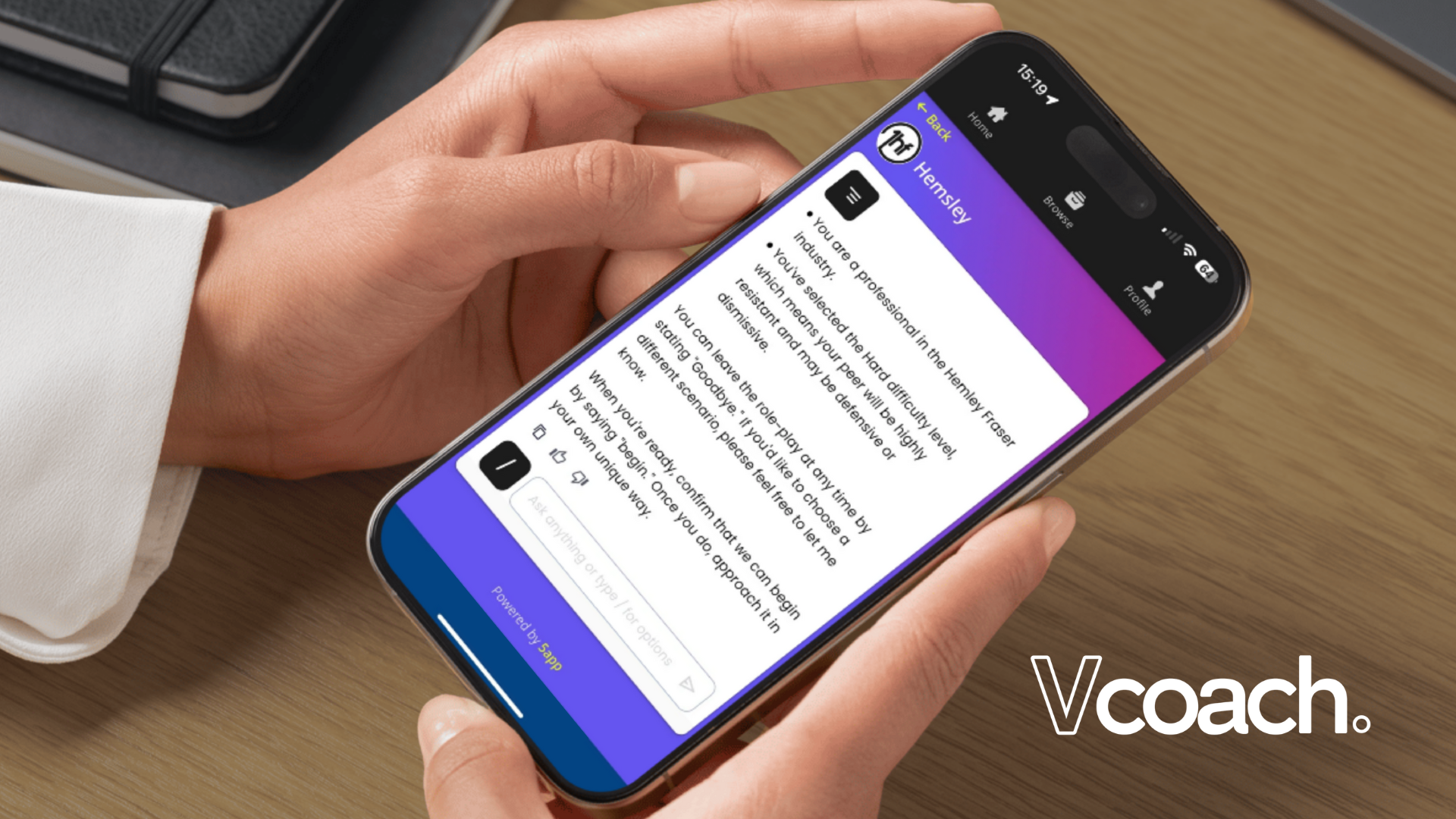
If you prefer to deliver learning interventions in the flow of work, AI roleplay may be a better option. Taking the scenario above, a learner can create a simple prompt along the lines of: "I'm a salesperson in the insurance industry and I need to practise my understanding of the latest anti-bribery regulations. Please play the role of a customer looking to bribe me into giving a preferential rate which allows me to test my skills."
Choosing an AI coach like VeeCoach is a great way to surface coaching and roleplay opportunities on demand. VeeCoach ingests content from your LMS, meaning any roleplay exercises are based on your organisation's own information rather than pulling resources from around the internet (which would be the case if your employees used a tool like ChatGPT for a similar roleplay experience).
VeeCoach can adapt exercises in line with the skills the employee is displaying, and can also offer feedback in the moment to keep compliance training feeling like more of a two-way conversation, which ultimately boosts engagement and nips misunderstandings in the bud.
3. Get to grips with gamification
Gamification is great for compliance training as it requires employees to actively engage with the subject matter. The more involved the employee is in the learning process, the more they will retain from the training.
.gif?width=423&height=282&name=Blog%20post%20images%20(2).gif)
For instance, many companies have seen great success using gamification for cybersecurity training. For example, employees may be presented with screenshots of emails, and asked to identify which are genuine and which are phishing emails. Turning it into a game and asking employees to apply their knowledge of cybersecurity best practices will in turn help them apply this in their own roles, which significantly boosts compliance over simply reading through the material.
You could even go a step further and create a leaderboard, allowing employees to compete with each other and rise the ranks. This adds an extra layer of gamification to the compliance training and may encourage some employees to revisit the training to improve their score – but you need to know your audience here, as not all employees will be motivated by competition.
4. Make the most of microlearning
If employees know they need to carve out an hour or two to complete their compliance training, they may put it off. Today’s employees are juggling lots of tasks, and an hour may seem like a big commitment for something that they may see as a distraction from their real work.
Instead of making compliance training feel like a slog, you can make it much more fun by drip-feeding content over a week or two. Delivering short, sharp compliance lessons and activities bit by bit will allow employees to chip away at their training without getting overwhelmed, and you could even include a quick five-question quiz after each learning asset to test understanding.
As with the language-learning app Duolingo, microlearning can be rolled out using the spaced practice concept, where learning is delivered in short 5-minute bursts every day to keep the subject matter front of mind. Using the 5app LMS, this could be delivered via a tailored nudge at a set time every day, reminding employees to keep engaging until they’ve completed all of the material for painless, high-impact compliance training.
5. Base training on real scenarios
Every single industry has faced compliance challenges, whether that’s fines for non-compliance, health and safety near-misses or severe reputational damage.
One of the best ways to learn is through real-life scenarios, and learning from the mistakes made in real non-compliance situations helps cement the right and wrong procedures in employees’ minds.

Finding examples from companies you know, or famous news stories, will help you add colour to your compliance training and make it more relevant. The risk of fines or failed audits can feel a bit abstract, but talking about well-known companies who have faced compliance challenges, such as Uber ignoring local transport laws or Facebook’s Cambridge Analytica scandal, means employees can put their newfound compliance knowledge to the test to explain how they would handle a situation differently.
It also acts as a reminder that things really do go wrong when laws, regulations and policies aren’t followed, and that consequences can often extend to the individual as well as the company.
If your own company has fallen foul of compliance rules in the past, use this as a learning opportunity. Use yourselves as a case study – ask employees to figure out where you went wrong previously, and what procedures they would follow to avoid the same issue in the future. Your senior leadership team can also clarify what changes were made (such as more robust review processes) to help employees stay compliant going forward.
FAQs about making compliance training fun